'%20stroke-width='9'%20/%3e%3cpolyline%20points='52,38%2032,60%2052,82'%20fill='none'%20stroke='url(%23g1)'%20stroke-width='9'%20stroke-linecap='round'%20stroke-linejoin='round'%20/%3e%3cpolyline%20points='68,38%2088,60%2068,82'%20fill='none'%20stroke='url(%23g1)'%20stroke-width='9'%20stroke-linecap='round'%20stroke-linejoin='round'%20/%3e%3ccircle%20cx='60'%20cy='60'%20r='7'%20fill='url(%23g1)'/%3e%3c/svg%3e)
What Actually Changed in 3D Printing in 2025

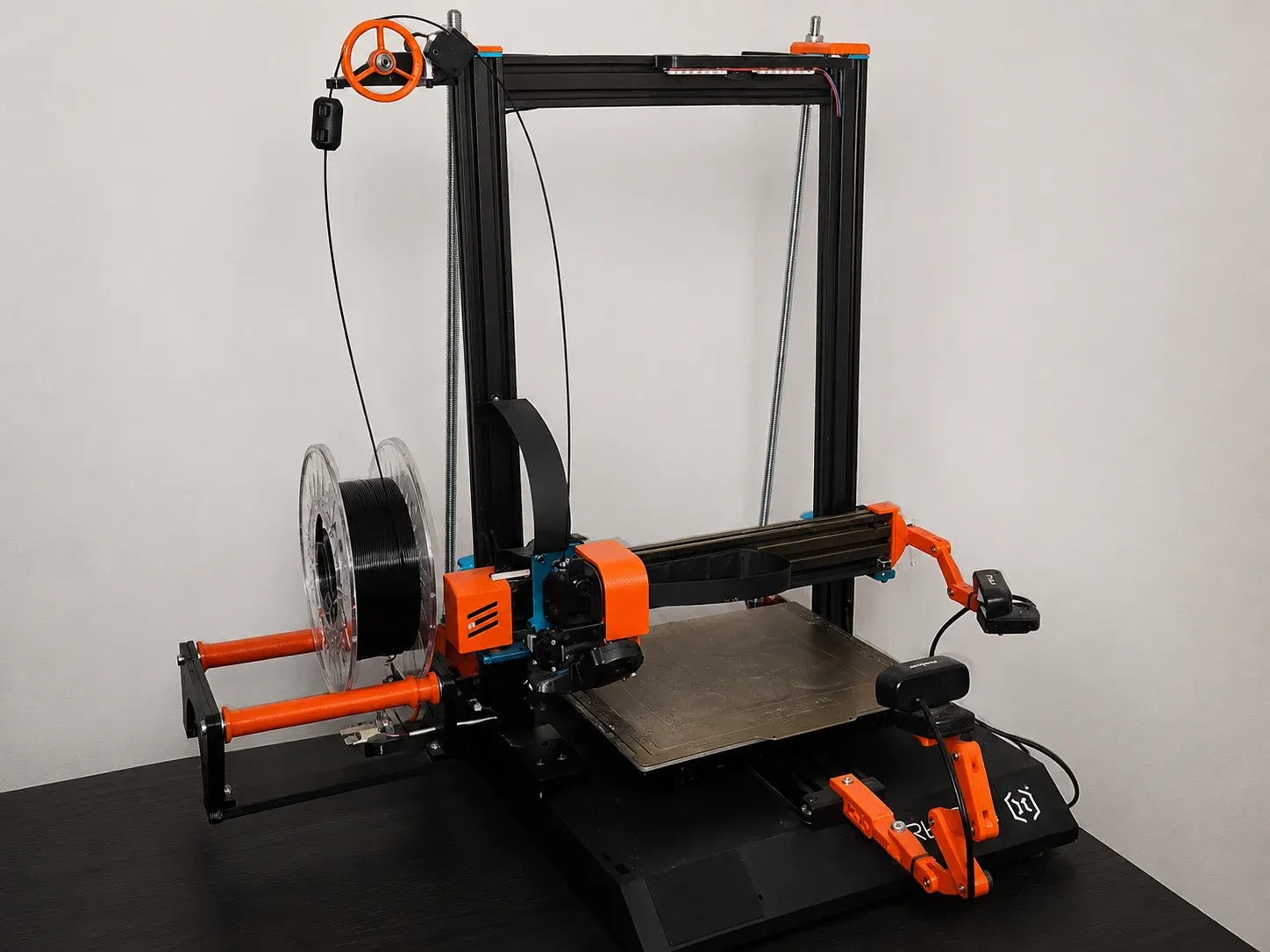
My printer is six years old and still does what I need, at the level of new 2025 consumer machines. Artillery Sidewinder X1 from 2019, plus Klipper, a filament weight sensor, a BLTouch probe, reinforced Z axes, a magnetic bed, an RPi4 running Mainsail and cameras. All of that cost me a few weekends instead of a new printer. A Bambu Lab P1S does roughly the same out of the box, for $700, half an hour after unboxing. That one sentence explains what actually changed in 3D printing since 2024.
Speed and AI are now default settings
The main 2024–2025 shift is that what the Klipper modding community has been doing for the past five years now ships from the factory. Input shaping, pressure advance, resonance compensation, first-layer autocalibration. Bambu Lab P1S and X1C handle it with zero config. Creality K1 Max caught up.
The 500–600 mm/s numbers printed on the boxes are marketing. Quality prints actually run at 200–300 mm/s, but that is still 3–4x faster than my stock Sidewinder before I flashed Klipper. The “AI” part on the printer side comes down to two things: visual error detection (a camera plus a model that recognizes spaghetti) and autocalibration. The rest is the word “AI” glued onto marketing one-pagers. “5G integration” is a pure buzzword, nobody seriously controls a printer through a carrier cloud. AI on the design side is further behind, I tried building an AI-driven 3D model generator myself and the takeaway is that LLMs aren’t replacing engineers yet, but in narrow domains (mounts, brackets, printer accessories) they start to make sense.
Materials and color: less than they promise
Carbon fiber composites and PA-CF were already available in 2022. “Biocompatible” filaments are usually PETG with some additive sprinkled into the datasheet. The 2025 novelty is availability and price, not technology. PA-CF from Bambu Lab now costs roughly what PLA cost a few years ago.
Multicolor through AMS (Bambu) or CFS (Creality) is great for figurines and demo prototypes, but every color change ends with a pile of waste in the purge tower. In real use it is an expensive toy. Full CMYK on a desktop (like the Flashforge CJ270) sounds impressive, but at that price point it mostly makes sense for ad agencies.
What the manufacturers will not tell you
Bambu Lab built the best consumer printers on the market and at the same time a closed ecosystem that resembles the iPhone. Forced cloud, their slicer, an AMS that only really works with their filaments. They have pushed at least one firmware update that made life harder for open-source tooling. Someone coming from Klipper notices, someone printing for the first time does not.
“Biodegradable filaments” deserves a sober comment too. PLA is technically biodegradable, but only under industrial composting conditions, not in your backyard compost bin or in a landfill. The ecology of 3D printing in 2025 still boils down to printing less waste than a multicolor purge tower throws away.
When to buy a new printer, and when to stick with your old one
If you are starting out, get a Bambu Lab P1S or Creality K2 Plus. Out of the box, works, no months of configuration.
If you have a printer from 2019–2021 and it still works, replacing it just for speed makes no sense. Klipper plus input shaping plus pressure advance is a weekend of work and most of the gains of new printers. My Sidewinder X1 still does what I need it to, better than most of the internet suggests it should.
Real reasons to upgrade: an enclosed chamber for ABS and ASA without warping, a CoreXY frame instead of a bedslinger (the Sidewinder hits its ceiling around 150 mm/s, no matter what you do with Klipper), multicolor if you actually print figurines. Or simply being tired of tinkering.
FAQ
Is Bambu really the best, despite the closed ecosystem?
For someone who wants to print rather than configure, yes. P1S and X1C deliver quality without weeks of tuning. The price is that you take their slicer, their AMS and their cloud. If you want control over firmware and an RPi inside, get something open-source running Klipper.
Which filament should a beginner start with?
PLA. Bambu PLA Basic, Polymaker PolyTerra or Sunlu PLA+ are all safe picks. Prints without an enclosure, low bed temperature, minimal warping. ASA and PETG are better in actual use, but with them you also have to learn slicer settings. First get a good-looking first layer on PLA, then experiment.
Can I use AMS without the Bambu cloud?
Mechanically yes, AMS talks to the printer controller over an internal connection. A full cloud cutoff (LAN-only mode in X1C) limits remote monitoring and some convenience features, but it doesn’t block multimaterial itself.
How long does a printer like the Sidewinder X1 actually last?
Mine has been running for six years and is still usable. I swap nozzles every so often (every 200-300 hours on abrasive filaments), belts every few thousand hours, the air filter, sometimes bearings. Frame, hotend and electronics are still stock. That’s cheaper than a new printer, until the mainboard starts going.
Does the “AI calibration” on new printers actually do something?
Yes, but mostly for the first layer and spaghetti detection. Auto-bed leveling with a force probe plus an algorithm is a real time saver vs manual. “AI spaghetti detection” is a computer vision model comparing the camera stream against the expected print appearance. It saves prints you wouldn’t catch in time otherwise, but it’s not magic, it’s an image classifier.
Is Klipper on an old printer enough to catch up with new machines?
On speed, yes (up to the mechanical limit, around 150 mm/s real for a Sidewinder), on quality too. What it won’t give you: an enclosed chamber for ABS/ASA, a CoreXY frame, multicolor without manual swaps. Klipper buys you about 80% of a new printer’s value for a weekend of work.